The DIM Weight Trap: How E-commerce Brands Lose 15% Profit Margin on Standard Boxes

In high-volume e-commerce operations, scaling efficiency is often subverted by a silent margin killer: rigid, off-the-shelf logistical configurations. Many brands optimize their digital acquisition funnels and product manufacturing costs, only to watch their net revenue erode within the supply chain. The primary mechanism driving this invisible financial leak is the Dimensional Weight (DIM) weight trap.
By relying on standard, pre-manufactured shipping boxes, enterprises routinely purchase and ship air, triggering excessive carrier fees that compromise bottom-line profitability. Transitioning from generic boxing to precision engineering is no longer just an operational upgrade; it is a critical strategy for margin protection.
Decoding the DIM Weight Equation
Carriers like FedEx, UPS, and DHL do not calculate shipping rates solely based on physical weight on a scale. Instead, they use a spatial billing metric known as Dimensional Weight, calculated by multiplying a package's length, width, and height, then dividing by a proprietary DIM factor. The shipper is automatically billed for whichever value is greater: the actual physical weight or the dimensional weight.
When an e-commerce operation uses standard, non-optimized boxes, the structural engineering is misaligned with the product profile. This mismatch forces fulfillment teams to rely on excessive void fillers like bubble wrap, air pillows, and kraft paper. While these materials keep products secure, they artificially inflate the cubic volume of the package.
According to logistics data, shipping products in oversized standard boxes increases shipping expenditures by up to 15% due to inflated dimensional assessments. For a high-volume merchant processing tens of thousands of orders monthly, this inefficiency represents a massive, compounding capital drain.
Precision Engineering as a Financial Asset
Mitigating carrier penalties requires a strategic shift toward data-driven, precise physical scaling operations. Transitioning to custom dimensions eliminates excess structural volume at the source, allowing brands to drop entire pricing tiers within carrier zone-charts.
When an enterprise integrates perfectly sized custom shipping boxes into its supply chain, the operational savings are immediate. Minimizing box volume reduces the dimensional footprint, maximizing pallet density during freight transport and reducing the overall cost-per-unit shipped.
Furthermore, removing excess void fillers streamlines warehouse throughput. Fulfillment teams spend less time assembling complex dunnage arrays, increasing packing-line velocity and lowering labor expenses per order. In modern logistics, structural material optimization is an essential lever for driving operational efficiency.
Overcoming Operational Friction in High-Volume Logistics
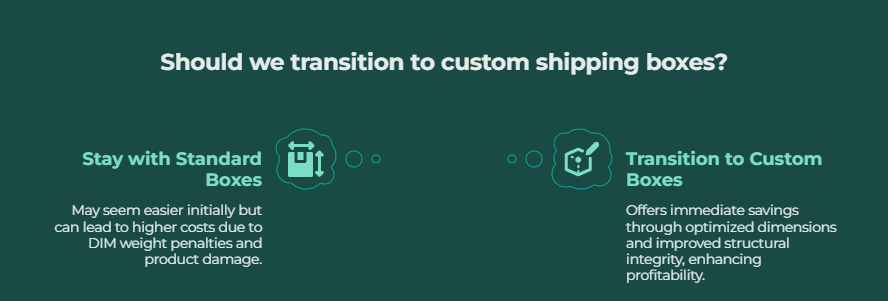
Many scaling brands hesitate to leave standard box vendors due to a perceived increase in procurement friction. They view custom packaging as a luxury branding asset rather than a functional, cost-saving engineering solution. This perspective misses a key operational truth: structural integrity and cost-saving metrics are deeply interconnected.
Standard boxes often lack the specific corrugation strengths needed for unique product weights, leading to higher damage rates during transit. According to supply chain research on carrier performance and fulfillment liabilities published by the Journal of Business Logistics, structural failures during final-mile delivery are a leading cause of costly product returns and inventory write-offs.
When a brand implements engineered custom mailer boxes, they solve both problems simultaneously. They optimize the outer dimensions to avoid DIM weight penalties while tuning the internal corrugation fluting (such as E-flute or B-flute) to match the product's exact weight. This targeted protection reduces product damage without adding unnecessary shipping weight.
Strategic Market Positioning: Transforming Waste into Capital
Every dollar saved on dimensional weight penalties and fulfillment waste goes directly to net margins, providing clean capital that can be reinvested into acquisition or product development. In a crowded e-commerce landscape where customer acquisition costs (CAC) continue to climb, protecting profit margins during fulfillment is a powerful competitive advantage.
Moving away from standard boxing allows an enterprise to stabilize its pricing models against carrier rate hikes, ensuring sustainable scaling. Aligning structural packaging design with precise logistics metrics transforms a standard expense line-item into a strategic engine for growth.
Conclusion: Data-Driven Logistics Safeguards Margins
The transition from standard, oversized boxes to precision-engineered packaging is a clear operational requirement for high-growth e-commerce systems. By eliminating empty space, reducing packaging waste, and avoiding DIM weight fees, brands protect their profits from unnecessary carrier costs. Treating your shipping container as a precision-engineered operational tool ensures your supply chain is built for profitable, long-term market dominance.


Comments