Why Toy Brands Are Phasing Out Plastic Packaging

The toy industry is currently facing a material challenge that structural design alone cannot fix. With the global toy market valued close to $90 billion, roughly 90% of all children's toys are still produced using plastic. While this was historically viewed simply as a standard manufacturing norm, it has rapidly evolved into a major commercial risk. Modern buyers are actively factoring environmental impact into their purchasing choices, prompting leading toy brands to systematically phase out plastic packaging.
The Statistic That Shifted Industry Perspective
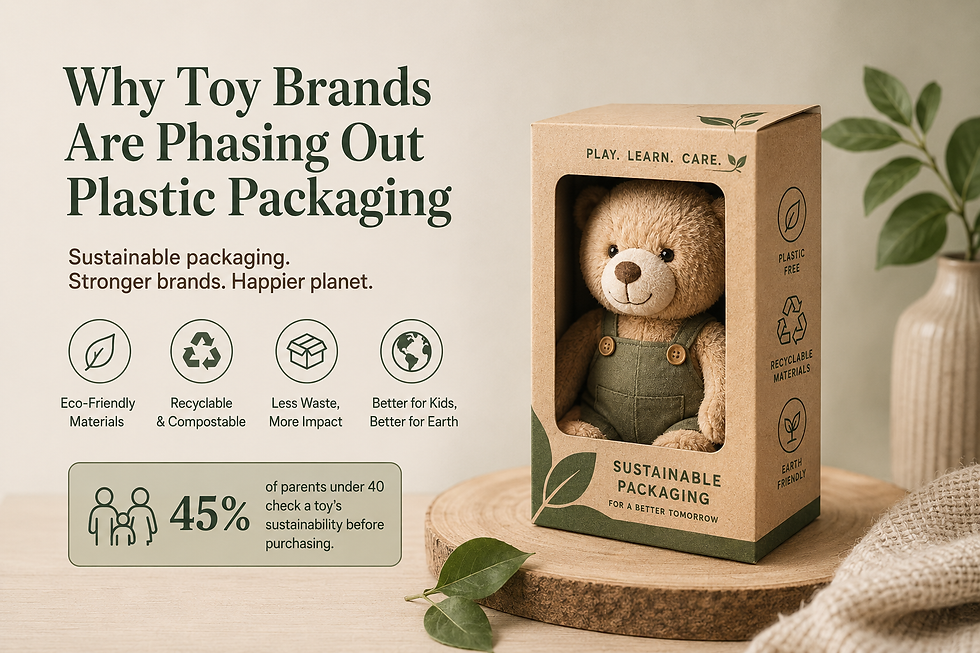
According to research from the Toy Association—the primary trade organization representing US toy manufacturers—45% of parents under the age of forty evaluate a toy's sustainability credentials prior to making a purchase. This is no longer a niche preference; it represents nearly half of the primary consumer base for an entire generation of buyers.
Why Packaging Carries Higher Stakes in the Toy Sector
Environmental considerations aside, toy packaging handles a level of brand responsibility that few other retail sectors encounter. Industry insights frequently highlight that packaging serves as the initial point of interaction for a toy. Rather than acting as a mere protective shell, it functions as an extension of the play experience itself, such as with L.O.L. Surprise! and often acts as the definitive tie-breaker between competing products on a busy store shelf. Consequently, eliminating plastic from packaging carries immense brand value because it impacts the single touchpoint doing the heaviest lifting to drive sales.
Why Major Toy Giants Prioritized Packaging First
Redesigning a toy's core plastic components involves complex safety protocols, expensive mold tooling, rigorous supply chain overhauls, and years of technical engineering. In contrast, altering packaging materials allows for much faster testing and deployment. Because packaging represents the outermost layer that customers evaluate before opening the box, major brands initiated their sustainability transitions here:
Transitioning to Alternative Materials: Manufacturers are actively adopting recycled or bio-based content for both products and outer layers, backed by public timelines for complete phase-outs.
Implementing Take-Back Programs: Several brands have rolled out organized recycling initiatives designed to reprocess returned plastics rather than sending them to landfills.
Adopting Compostable Alternatives: Specific product lines have completely swapped out traditional blister packs and plastic films for compostable alternatives derived from bamboo, sugarcane, and wood.
Eliminating Excess Elements: Industry leaders have made public commitments to entirely remove non-essential packaging elements, including polybags, shrink wrap, elastic bands, and plastic windows on fresh product drops.
While none of these transitions are inexpensive or instantaneous, they share a unified strategy: packaging serves as the quickest operational lever a brand can pull without waiting to completely redesign the underlying product.
The Viable Roadmap for Emerging Brands
Independent and smaller toy companies do not require massive enterprise engineering budgets to adopt this strategy. Utilizing custom packaging solutions crafted from recyclable paper stocks or reduced-material components allows smaller brands to phase out plastic immediately. This mirrors the exact rollout sequence successfully proven out by larger market players.
Common Missteps to Avoid
Treating Sustainability as a PR Gimmick: Launching a superficial green marketing campaign without executing actual material changes quickly backfires with an informed consumer base.
Failing to Communicate On-Pack: Eliminating plastic elements without clearly highlighting the change directly on the packaging means the effort fails to influence the buyer at the shelf.
Equating Plastic Reduction with Lower Quality: Assuming that moving away from plastic automatically degrades structural integrity or shelf appeal, when proper material planning keeps both elements fully aligned.
The Operational Trade-Offs
This operational shift does not happen without friction. Toy packaging must still satisfy strict safety benchmarks, drop-durability requirements, and international shipping constraints that limit how lightweight or compostable a material can safely be. Balancing ecological targets against product safety and cost remains a legitimate engineering challenge rather than a simple marketing preference.
The Bottom Line for Decision Makers
Phasing out plastic packaging is no longer driven by charity or pure corporate philanthropy. Instead, it is a calculated business move targeted directly at a purchasing preference held by nearly half of a crucial buyer demographic, executed on the exact touchpoint that dictates a toy's market success.
Frequently Asked Questions (FAQs)
Q1: Why are toy brands moving away from plastic packaging? Toy brands are eliminating plastic packaging primarily due to shifting consumer demand. With nearly 45% of younger parents prioritizing sustainability when buying toys, brands view sustainable packaging as an essential growth strategy and risk-mitigation tool rather than just an environmental initiative.
Q2: Is phasing out plastic packaging expensive for toy manufacturers? Yes, transitioning away from traditional plastics involves initial financial investment and technical adjustments. However, altering packaging materials is significantly faster and more cost-effective than completely redesigning a toy's core plastic structure, making it the most practical starting point for brands.
Q3: Does removing plastic packaging affect the safety and durability of toys? Brands must carefully balance environmental goals with strict safety, shipping, and durability requirements. Modern eco-friendly alternatives, such as reinforced paper stocks and specialized plant-based materials, are engineered to protect products just as effectively as traditional plastic blister packs.
Q4: How can smaller toy brands implement sustainable packaging? Smaller brands can start by replacing traditional plastic windows, polybags, and inserts with custom-designed recyclable alternatives or paper-based materials, following the phased rollout models successfully used by major industry leaders.


Comments